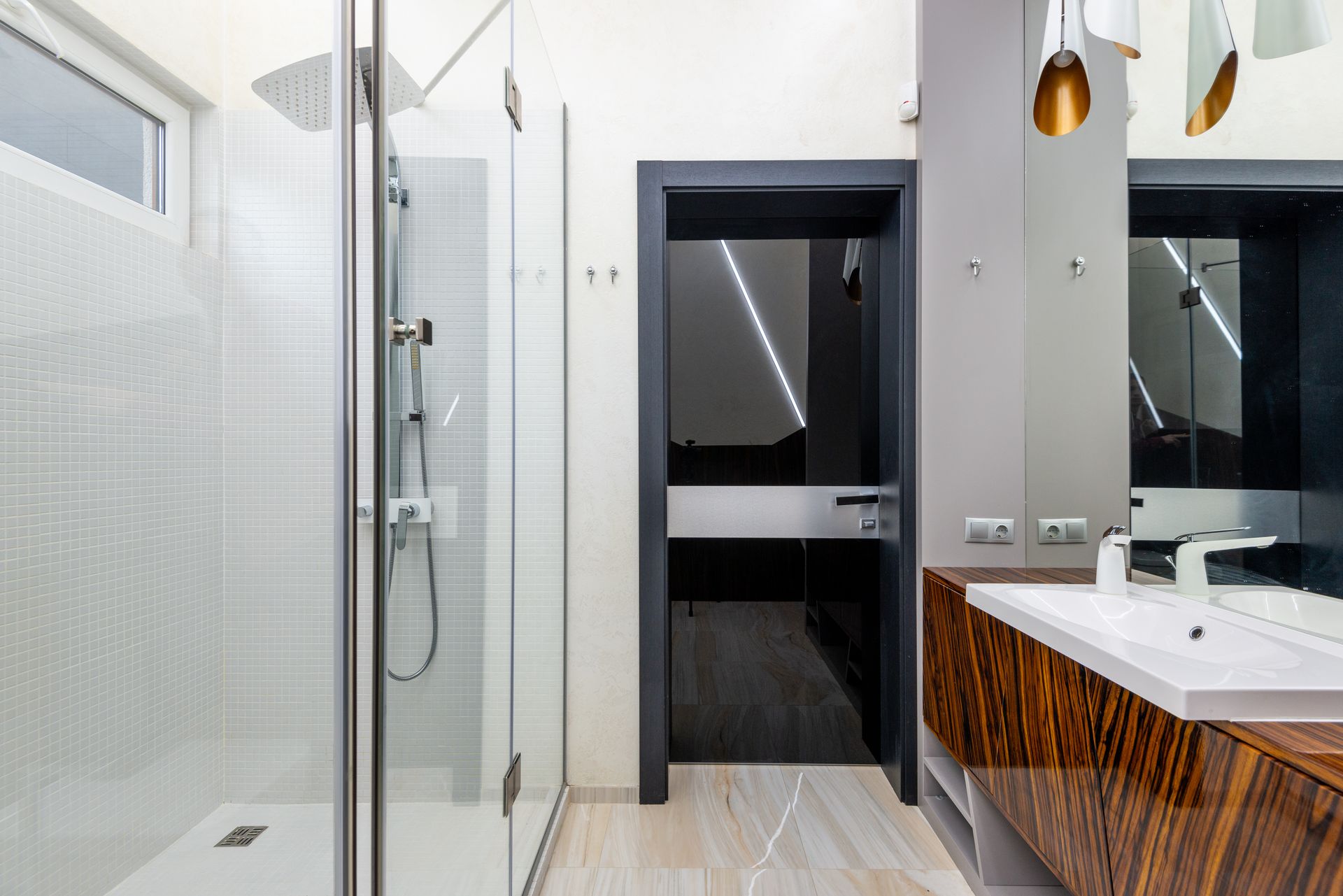
Residential Glass Services
Framed & Semi-Frameless Shower Doors
Not every bathroom needs full frameless — and not every budget wants it. We design, fabricate, and install framed and semi-frameless glass shower doors across Orange, Ulster, and Dutchess Counties that look clean, seal properly, and last. Owner Rick Powles measures every opening himself and is on every installation. "My new shower doors are exactly what I was envisioning and Nu-Glass brought them to life."
What We Do
- ✓ Framed shower doors — metal channel around the glass for a traditional, budget-friendly look
- ✓ Semi-frameless shower doors — framing on the walls, none on the door itself
- ✓ Sliding (bypass) shower doors — for tubs and showers where a swing door won't fit
- ✓ Swing (pivot) shower doors — in-swing and out-swing configurations
- ✓ Tub enclosures — framed sliding doors for standard tub openings
- ✓ Replacement doors — fit to your existing framing or rail system
Framed vs. semi-frameless vs. frameless: picking the right style for your bathroom
Shower doors come in three basic style categories, and each has a distinct look, price point, and maintenance profile. Here's the honest breakdown:
Framed shower doors use a metal frame — typically aluminum in chrome, brushed nickel, or oil-rubbed bronze — that surrounds all four sides of the glass panel and runs along the bottom of the opening. The frame provides the structure and the sealing surface. Framed doors use thinner glass (usually 3/16″ or 1/4″) because the frame does the structural work, which keeps the cost lower than frameless options. The tradeoff is the visual presence of the frame itself and the bottom track, which can accumulate soap scum over time. For bathrooms where cost is the primary driver and the look is functional rather than spa-like, framed doors are the right call.
Semi-frameless doors split the difference. The wall channels and top rail are framed; the door itself has no frame around it. The glass is slightly thicker than fully framed (often 5/16″) and the look is cleaner — fewer visible metal edges — without the cost of full frameless. Semi-frameless is the most common choice on mid-range bathroom renovations in the Hudson Valley.
Frameless doors eliminate the perimeter channel entirely. For the full frameless story — glass thickness options, hardware finishes, and configurations — see our frameless shower enclosures page. We build all three styles; we'll recommend what makes sense for your bathroom, budget, and tile configuration.
Sliding (bypass) shower doors: when they're the right choice
Sliding shower doors — sometimes called bypass doors — consist of two glass panels that slide past each other on a track, one in front of the other, so you can open either side. They require no clearance outside the shower to swing a door, which makes them the right choice in any bathroom where space is tight or the shower/tub is positioned against a wall or vanity that would block an outward-swinging door.
Standard sliding door configurations come in aluminum frame systems for tub openings (typically 56″ to 62″ wide) and wider custom configurations for shower openings. The glass is usually 3/16″ or 1/4″ tempered, held in the track with rollers at the top and guided at the bottom.
The maintenance consideration with sliding doors is the bottom track: water, soap residue, and shampoo collect in the track and have to be cleaned regularly to prevent mildew and keep the rollers running smoothly. Some newer sliding systems use a frameless or semi-frameless approach with a minimal bottom guide rather than a full track — cleaner aesthetically and easier to clean, though more expensive. We can show you what's available for your opening size.
Sliding doors are also the standard solution for tub enclosures — the bathtub-height configuration most commonly seen in older homes that are being updated. We replace tub enclosures regularly across Orange, Ulster, and Dutchess Counties, and most standard tub openings can be fitted with a new sliding door system in a half-day installation.
Swing doors: in-swing, out-swing, and what your bathroom layout determines
A swing (pivot) shower door opens on a hinge — either inward into the shower, outward into the bathroom, or both (a reversible configuration). The choice of swing direction is largely determined by the bathroom layout and the shower footprint:
Out-swing is the default for most shower configurations. The door swings out into the bathroom, which means you need clearance in front of the shower — usually 24″ to 30″ — for the door to open fully. Out-swing doors are easier to enter and exit because you don't have to step back inside a wet shower to close the door behind you.
In-swing is used when the bathroom layout doesn't allow clearance for an out-swing — a vanity directly opposite the shower, a tight hallway bathroom, or a corner configuration where out-swing would hit something. The door opens into the shower space itself. In-swing requires a large enough shower footprint (36″ × 36″ minimum) to allow the door to open without hitting the showerhead or fixtures.
Reversible (bifold) doors fold in the middle and can be installed to open either direction, or to fold partially into the shower and partially out. These are useful in very tight spaces. We can advise on which swing configuration works for your bathroom based on the actual dimensions.
Glass options: clear, low-iron, frosted, and patterned
Standard shower door glass is clear tempered — transparent, with the slight green tint inherent in standard float glass. For most bathrooms, this is exactly right. But there are situations where a different glass type improves the result:
Low-iron glass (sometimes called "ultra-clear" or "Starphire") eliminates most of the green tint in standard glass, producing a brighter, more neutral transparency. The difference is visible when the glass is edge-on — standard glass has a distinctly green edge, low-iron glass is nearly clear all the way through. If your bathroom tile is white, gray, or any neutral tone where the glass tint would show, low-iron glass makes the enclosure look cleaner and more intentional. It costs a premium over standard clear.
Frosted glass is either acid-etched (a chemical process that creates a permanent matte surface) or coated. Frosted glass provides privacy while still allowing light through — useful in a shared bathroom or a configuration where the toilet is visible through the shower glass. Full frosting or partial frosting (a banded stripe at eye level) are both options.
Patterned glass — reeded, fluted, rain, or other textured patterns — is a design choice that adds visual interest while also providing some privacy. It's been gaining popularity in Hudson Valley bathroom renovations over the last few years as a departure from the uniformly clear glass look. We can source most standard patterns.
Measuring your opening — why it matters and what we look for
The biggest mistake in a shower door installation is measuring wrong. Shower openings are almost never perfectly square — tile work varies, walls are rarely perfectly plumb, and the floor isn't always level. A door that's cut to the nominal opening size without accounting for those variations won't fit correctly, won't seal, and will look crooked.
When Rick Powles measures your shower opening, he's taking more than a single width and height measurement. He checks the plumb of both walls (how far off vertical they are), the levelness of the floor, the size and position of any threshold or curb, the clearance above the opening, and the tile configuration at the walls (tile edge vs. bullnose vs. a return). All of those factors affect how the door and frame are fabricated and how the installation goes.
Field measurement is a free part of the job for us — we don't quote and commit to fabrication from measurements you send us. We come out, measure correctly, and quote based on what we actually see. That's how we've worked for 35 years, and it's why the installations we do fit correctly the first time. Part of our full residential glass services.
Replacing an existing shower door: what to expect
Most of the shower door work we do for homeowners in Poughkeepsie, Beacon, Middletown, Kingston, and Newburgh is replacement — an existing door that's old, damaged, leaking, or simply outdated. Here's how that typically goes:
We assess the existing door and frame to determine whether the existing wall channels and header can be reused or need to come out. In many cases the wall channels can stay if they're solid and correctly positioned — we're only replacing the door and glass, which saves time and avoids retiling. If the existing channels are corroded, loose, or a different size than the new system, they come out and we start with a clean wall surface.
The new door system goes in, the gaps between the frame and the tile are caulked, and we adjust the door to swing and seal correctly. Cleanup, walkthrough, done. A standard replacement is typically a half-day job on-site. If you're also planning to retile or remodel the shower, the right time to do the door is after the tile is set and grouted — we need a finished surface to measure from and to seal against. See our frameless shower enclosures page if you're considering the upgrade while you're already opening the bathroom up.
Written & verified by
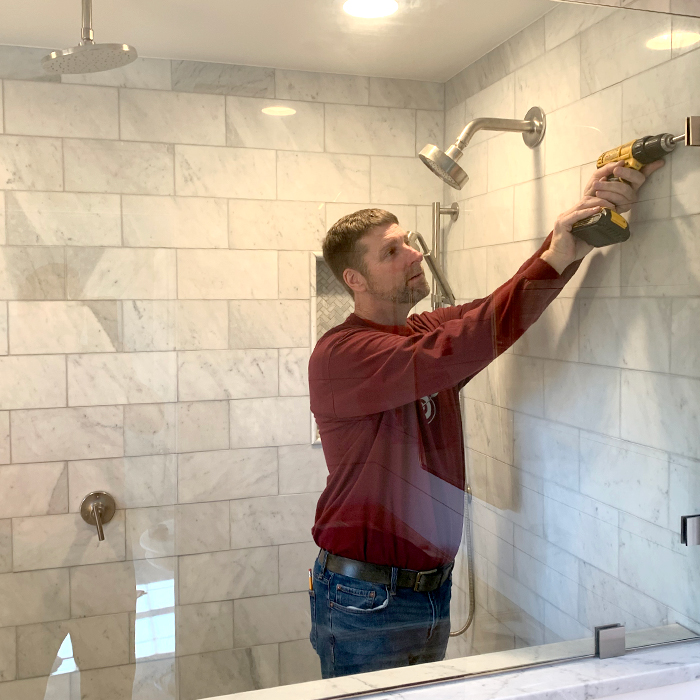
Rick Powles
Owner & Operator, Nu-Glass & Storefronts, Inc.
Rick Powles has measured, fabricated, and installed commercial glass and glazing systems across the Hudson Valley since 1989. As owner-operator, he is on every job — storefronts, curtain wall, frameless showers, and everything in between.
FAQs
Frequently asked questions
-
What's the difference between framed, semi-frameless, and frameless shower doors?
Framed doors have a metal channel all the way around — most economical, thinner glass. Semi-frameless has framing on the walls but not on the door itself — a cleaner look at a mid-range price. Frameless uses thick tempered glass with no perimeter frame — the most open look at the highest cost. We help you pick the right one for your bathroom and budget.
-
Can you replace an old or broken shower door without retiling?
Usually yes. In most cases the existing wall channels can stay if they're solid and correctly positioned — we replace the door and glass without touching the tile. If the channels are corroded or a different size, we remove them and install a new system, leaving the tile in place.
-
Do you install sliding shower doors for tubs?
Yes — we install sliding (bypass) shower and tub enclosures in standard and custom widths. Sliding doors are the right choice when there's not enough clearance for a swing door to open into the bathroom.
-
How long does a shower door installation take?
A replacement installation (existing channels staying) is typically a half-day. A full new installation from scratch, including wall channels and all new hardware, is usually a full day. Custom frameless configurations may run longer depending on complexity.
-
Can you match my existing bathroom hardware finish?
Yes — we offer chrome, brushed nickel, matte black, oil-rubbed bronze, and brushed gold to match your existing fixtures. Matching the finish across the enclosure and your other bathroom hardware is one of the details that makes the final result look intentional.
Get Started
Need framed & semi-frameless shower doors?
Call the shop or request a free estimate — we'll measure, quote, and get it done right.