Commercial Glass & Glazing
Office Glass Partitions
Glass partitions let light move through a workspace without noise following it. Nu-Glass & Storefronts installs framed, frameless, and demountable glass partition systems for offices, conference rooms, and commercial interiors across the Hudson Valley — family-owned and Newburgh-based since 1989, with owner Rick Powles on every job.
What We Do
- ✓ Framed glass partition systems — floor-to-ceiling office and conference room walls
- ✓ Frameless glass walls — heavy tempered glass with minimal hardware for a clean look
- ✓ Demountable partition systems — relocatable without damage to the structure
- ✓ Door integration — swing doors, sliding doors, closers, and locks in matching hardware
- ✓ Privacy glass — frosted, acid-etched, and film treatments for partial or full privacy
- ✓ Interior glazing — reception sidelites, borrowed lights, and pass-throughs
Framed vs. frameless glass partitions: choosing the right system
The choice between framed and frameless glass partitions comes down to aesthetics, budget, and how the partition will be used. Neither is universally better — the right system depends on your space and what you're trying to achieve.
Framed glass partitions use an aluminum frame — typically 2" to 3" wide — around the perimeter of each glass panel. The frame is visible and provides the structure that holds the glass in place. Framed systems are more economical than frameless, easier to modify if you need to add or move a door, and well-suited to offices where flexibility matters more than a minimalist look. The aluminum frame can be finished in clear anodized, dark bronze, or black to match your interior. Most commercial office partition work in the Hudson Valley uses framed systems because the cost-to-performance ratio is excellent.
Frameless glass partitions use thicker tempered glass — typically 3/8" or ½" — with minimal or concealed hardware at the head and base. There's no visible frame around the glass, which creates a clean, all-glass aesthetic that works particularly well in conference rooms and executive offices. The tradeoff is cost: frameless systems require heavier glass, more precise fabrication and installation, and more complex hardware. They're also less flexible — adding or moving a door in a frameless wall is harder than in a framed system.
We'll walk you through which system makes sense for your specific space, budget, and use before any glass is ordered.
Demountable partition systems: when flexibility is worth the investment
A demountable glass partition system is designed to be taken apart and reinstalled elsewhere without damaging the floor, ceiling, or walls. The glass panels, framing, and hardware all connect with mechanical fasteners and fit into a channel system that doesn't require cutting into the building structure. When you need to reconfigure the office, the partition goes with you — no patching, no repainting, no structural remediation.
Demountable systems cost more upfront than conventionally installed partitions. The investment pays back in two situations: when you have a lease and plan to take the partition with you at the end of it, or when you expect to reconfigure your office layout within the next five years and want to avoid paying twice for the same partition square footage.
A conventional framed glass partition — anchored into the slab above and the floor below with sealant and mechanical fasteners — is a permanent installation. Moving it means cutting it out, patching the floor and ceiling, and reinstalling. That's a significant cost if you do it even once. Demountable systems amortize their premium over the flexibility they provide.
We advise on whether a demountable system is the right fit for your situation before you commit to one. The decision depends on your lease terms, your building type, and how certain you are about your layout over the next few years.
Hardware, finishes, and door integration
A glass partition system is more than glass — the hardware and finish details determine how the wall looks and how well it functions over time. Here's what goes into a complete partition installation:
Aluminum frame finishes. We finish partition framing to match your interior — clear anodized for a neutral, professional look; dark bronze for warmer interiors; matte black for modern offices. Custom powder coat colors are available. Getting the finish consistent between the partition frames and existing aluminum in the space (window frames, ceiling grid, etc.) makes a significant difference in the finished look.
Door integration. Most glass partition walls incorporate at least one door. For framed systems, the door frame is part of the partition framing system — the door swings in a standard aluminum doorframe with a standard closer, latch, and handle. For frameless systems, the door is typically a frameless glass swing door or a sliding barn-door-style panel, with point hardware (hinges and pivot hardware set into the glass itself). We handle the full door package — glass, frame, closer, lock, and handles — in matching finishes.
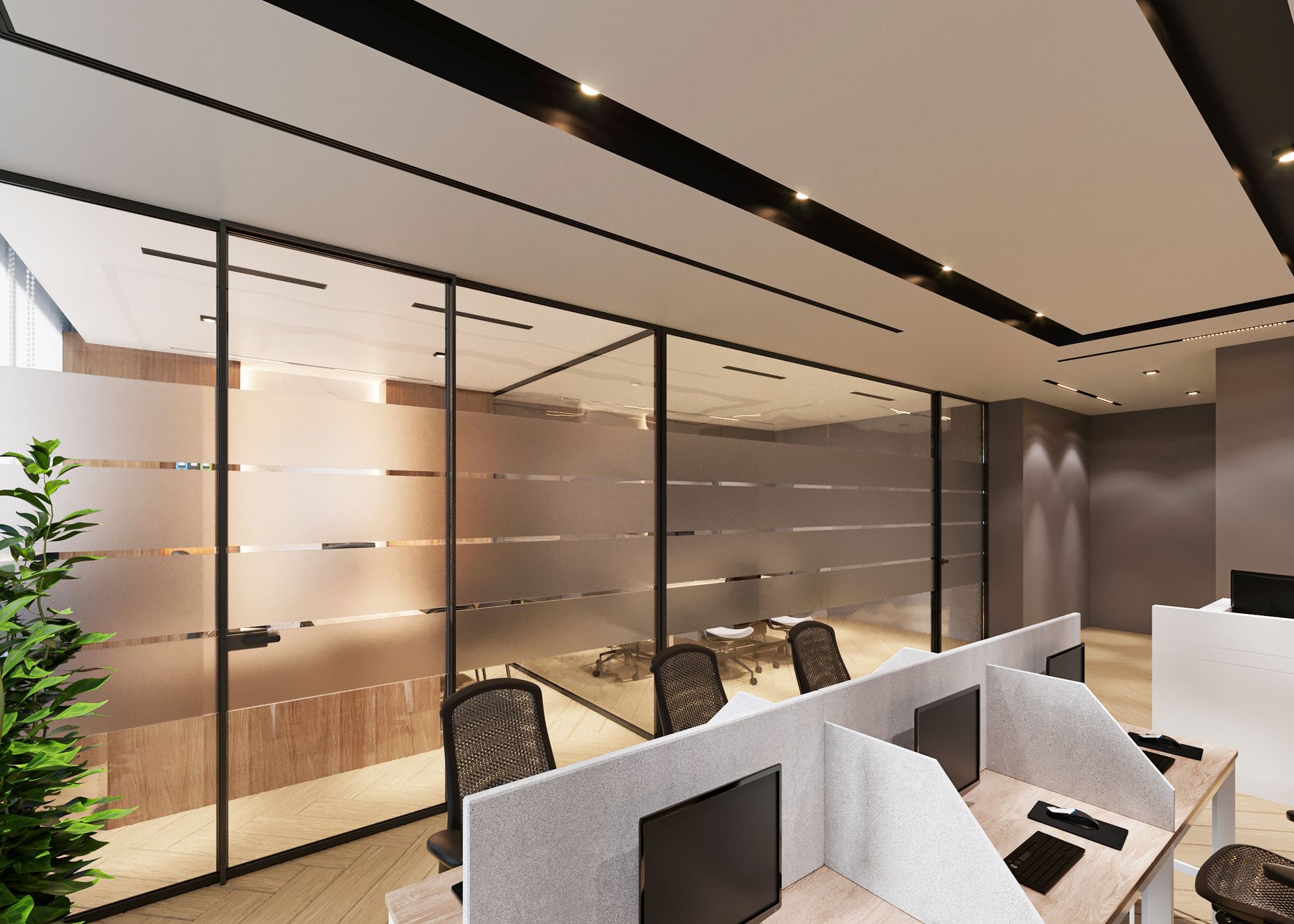
Privacy treatments. Open offices often need partial privacy in specific areas — private offices, HR rooms, or conference rooms where what's discussed shouldn't be visible from the floor. Options include frosted or acid-etched glass (full or partial), applied film (removable and repositionable), and patterned glass. We offer full-coverage frosting for maximum privacy, banded frosting (a frosted stripe at eye level with clear glass above and below) for a balance of privacy and openness, and gradient or decorative patterns. For hardware on glass door systems within partitions, see our door closures & hardware page.
Acoustic performance: managing sound in glass-walled offices
The most common concern clients raise about glass partitions is sound: will a conference room glazed in glass actually keep conversations private? The answer is yes — if the system is specified and installed correctly. Here's how sound control works in glass partition systems.
Sound transmission through a glass panel is characterized by its STC (Sound Transmission Class) rating. The higher the STC, the better the sound isolation. A standard 1/4" single-pane glass panel has an STC of roughly 31 — adequate for general office background noise but not for confidential conversations. A 3/8" single-pane panel improves to about STC 34–35. Laminated glass of the same thickness significantly outperforms monolithic glass because the PVB interlayer damps resonance — a laminated 1/4" panel can reach STC 38 or better.
For conference rooms and private offices where speech privacy matters, we recommend: laminated glass in the partition panels, full-height installation to the underside of the deck (not stopped at the ceiling tile), and careful sealing at the head, base, and door frame to eliminate flanking paths. The door is frequently the weak point in the acoustic envelope — a poorly fitted door with an air gap at the bottom loses most of the acoustic benefit of the glass. We install and adjust doors in partition systems to close fully and seal against the frame.
We'll advise on the STC performance of each system option and help you understand what level of speech privacy to expect.
Glass partitions and building permits in New York
Whether a glass partition installation requires a building permit in New York depends on the municipality, the scope of work, and whether the partition constitutes a structural modification to the building. Here's the general picture based on our 35+ years of commercial work in Orange, Ulster, and Dutchess Counties:
Simple partitions in leased commercial space — a glass wall added inside a tenant improvement — often fall under the landlord's existing Certificate of Occupancy and don't require a separate permit, particularly if they don't affect the building's fire-rated assemblies, plumbing, or electrical systems.
Partitions that affect fire-rated corridors, egress paths, or fire-separation requirements do require a permit and must be installed in compliance with the building's fire protection plan. A glass partition that creates or modifies a fire-rated enclosure has to use fire-rated glass and a tested assembly.
Structural modifications — anchoring to the structural slab above, penetrating the roof or floor assembly — typically require a permit regardless of the partition type.
We advise on what's likely required in your specific municipality and for your specific scope. We've installed glass partitions in commercial buildings throughout the Hudson Valley and know what the local building departments typically require. If a permit is needed, we can provide the documentation of the installation to support the permit application. Part of our full commercial glass & glazing services.
Glass partitions vs. drywall: a realistic comparison
The most common alternative to a glass partition wall is drywall — and the comparison comes up on most commercial buildout projects. Here's an honest breakdown:
Light. This is the strongest argument for glass. Drywall eliminates daylight in interior spaces, which increases lighting costs and negatively affects occupant wellbeing and productivity. Glass partitions maintain the flow of natural light through the building, reduce the need for artificial lighting in interior offices, and contribute to a better working environment. Studies on office worker productivity consistently show better outcomes in naturally lit spaces.
Acoustic performance. Well-specified drywall walls — particularly double-layer drywall with insulation — can outperform glass at the same cost for pure acoustic performance. A glass partition can achieve excellent speech privacy with the right specification, but it requires laminated glass, full-height installation, and careful door sealing. If pure acoustic isolation is the priority and appearance doesn't matter, drywall is hard to beat per dollar.
Cost. On a straight material and labor basis, drywall is less expensive than glass. A glass partition system — including the framing, glass, and door — costs more than the equivalent drywall partition. The premium is real, and it pays back in light transmission, visual openness, and resale/rental value of the space. Many tenants and building owners find that glass-walled offices command higher rents and are easier to lease than closed drywall offices.
We'll give you a straight number for the glass partition option so you can compare it directly to drywall bids. No inflation of the benefits, no minimizing the cost.
Written & verified by
Rick Powles
Owner & Operator, Nu-Glass & Storefronts, Inc.
Rick Powles has measured, fabricated, and installed commercial glass and glazing systems across the Hudson Valley since 1989. As owner-operator, he is on every job — storefronts, curtain wall, frameless showers, and everything in between.
FAQs
Frequently asked questions
-
What's the difference between a framed and frameless glass partition?
Framed partitions have an aluminum frame around the glass — more economical and flexible. Frameless uses thicker tempered glass (3/8" or 1/2") with minimal hardware for a clean, all-glass look at a higher cost. We help you choose based on your space, use, and budget.
-
Can glass partitions be moved if we reconfigure the office?
Demountable partition systems are specifically designed to be taken apart and reinstalled without damaging floors, ceilings, or walls. Conventional partitions are permanent installations. We'll advise on whether a demountable system is worth the investment for your situation.
-
Can you integrate a door into a glass partition wall?
Yes — swing or sliding doors with closers, locks, and handles in finishes that match the partition frame. We handle the full door package, not just the glass.
-
What privacy options are available for glass partitions?
Frosted or acid-etched glass, applied film, and patterned glass are all options. We can do full coverage for private offices, banded frosting (a stripe at eye level with clear glass above and below), or custom patterns. Film is removable if your needs change.
-
How long does a glass partition installation take?
A standard framed partition project — measuring, fabrication, and installation — typically takes two to four weeks from order to completion. Frameless systems with custom heavy glass take a bit longer. We give you a timeline before you commit.
Get Started
Need office glass partitions?
Call the shop or request a free estimate — we'll measure, quote, and get it done right.