Residential Glass Services
Custom Mirrors
We cut mirrors to your exact measurements — wall, vanity, bathroom, and gym mirrors — with the edge finish and mounting you want. Many custom mirrors are ready the next day. Homeowners across Orange, Ulster, and Dutchess Counties order custom mirrors from our Newburgh shop, and we cut to any size, rectangular or custom shape. One customer says it best: "Custom cut mirror, 100% to my measurements."
What We Do
- ✓ Custom wall and vanity mirrors — any rectangular size cut to your measurements
- ✓ Bathroom mirrors — cut to fit above a single or double vanity, with your edge finish
- ✓ Full-wall gym and studio mirrors — large-format, installed to floor-to-ceiling or panel-by-panel
- ✓ Frameless mirrors — polished, beveled, or seamed edges for a finished look without a frame
- ✓ Closet and wardrobe mirrors — sliding door panels, bifold panels, or full-length fixed
- ✓ Mirror installation — wall-mounted with cleat, clip, or adhesive systems
Why a custom mirror looks better than anything off the shelf
Standard mirrors come in standard sizes: 24″, 30″, 36″ wide, a fixed height, a frame that may or may not match anything in your bathroom. A custom mirror is cut to the exact dimensions of your space — the full width of your vanity, the exact height from the countertop to the ceiling, the right size to fill the wall above a soaking tub without cutting off awkwardly at the edge of the tile.
The difference is visible immediately. A bathroom mirror that fills the space looks intentional. One that's slightly too narrow or too short looks like an afterthought. The same principle applies to gym mirrors, entry mirrors, and full-wall decorative mirrors — the right size is the size that fits the actual wall, not the largest stock size that's close enough.
Custom cutting doesn't cost dramatically more than buying a large stock mirror when you factor in the quality difference and the precision fit. Our shop in Newburgh cuts custom mirrors daily — the setup cost for a one-off piece is minimal, and we cut most rectangular sizes the same day or next day from stock mirror glass. Complex shapes (oval, arch, irregular) take a bit longer because we template or digitize the shape first.
We also stock several different mirror qualities, and the quality of the mirror glass matters for how it reflects: see the section below on reflective quality.
Edge options: polished, beveled, seamed, and sandblasted
The edge of a mirror is what you see when you look at it from the side or from an angle, and it determines whether the mirror looks finished or raw. Here are the options we offer:
Polished edge is the standard for a frameless mirror. The raw-cut glass edge is ground smooth and then polished to a bright, transparent finish. A polished edge is clean and refined — appropriate for bathroom vanity mirrors, bedroom mirrors, and any application where the edge is visible. The edge is glass-clear and lets you see the thickness of the mirror.
Beveled edge adds a decorative angled grind around the perimeter — typically 1″ wide at a 20–30° angle — that catches light and adds visual interest. Beveling was the dominant edge choice for decorative mirrors for decades and still looks elegant in traditional bathroom settings. It adds cost over a standard polished edge but the effect is genuinely distinctive.
Seamed edge is a simple grind that removes the sharp factory-cut edge and leaves a smooth but not polished surface. It's the right choice for mirrors that will be framed, set into channels, or otherwise have their edges covered — the seam prevents cuts during handling and installation without the cost of a full polish.
Sandblasted edge creates a frosted, matte finish on the cut edge rather than a polished one. Used decoratively on mirrors where the edge is part of the visual design — a sandblasted border or a frosted band around the perimeter. We can combine polished and sandblasted surfaces on the same mirror for custom decorative effects.
Mounting options: clips, cleats, French cleats, and adhesive
How a mirror is mounted determines whether it stays on the wall and whether it can be removed without damaging the wall finish. We use different mounting systems depending on the mirror size, weight, and the type of wall.
J-channel and mirror clips are the most common system for residential bathroom mirrors up to about 24″ × 36″. A J-shaped metal channel along the bottom supports the mirror weight; plastic clips at the top and sides hold it flat against the wall. Simple, economical, and easy to remove. The clips are available in chrome, nickel, and black to match your bathroom hardware.
French cleats are the right choice for large, heavy mirrors — full-wall gym mirrors, large bathroom mirrors, and mirrors that weigh more than 30–40 lbs. A French cleat is a pair of interlocking wooden or aluminum brackets: one mounted to the wall, one on the back of the mirror. When the mirror is hung, it locks in place securely and can be removed by lifting straight up. French cleats distribute the weight across a wide bearing surface and can be anchored into studs or wall anchors.
Adhesive mounting — mirror mastic or structural silicone — bonds the mirror directly to the wall without visible hardware. It's a clean look that completely eliminates clips and brackets, but it's more or less permanent: removing an adhesive-mounted mirror often damages the wall finish behind it. We use adhesive mounting on mirrors that will stay in place indefinitely and on drywall or backer board that can handle the bond. We don't use standard mirror mastic on painted surfaces over plaster without first confirming adhesion compatibility.
Gym and studio mirrors: getting a full-wall installation right
Full-wall gym mirrors — the kind you see in a home gym, yoga studio, or dance studio — require more planning than a single vanity mirror because the installation involves multiple panels, consistent reveals between panels, and a perfectly level, plumb result across the full wall.
Here's how we approach a gym mirror installation:
Wall assessment. The wall has to be flat and the floor level — or we have to account for variations in how the panels are set. We measure the wall, mark stud locations for any anchor points, and determine the panel layout before any glass is cut.
Panel layout. A full-wall gym mirror is typically broken into panels for practicality — a single piece of mirror 8 feet × 8 feet is extremely heavy, difficult to transport and handle, and will crack from even small wall deflections over time. We lay out panels to fit the wall in a logical grid, with consistent joint widths between panels. The joints can be tightly butted (minimal gap) or can have a small reveal that looks intentional.
Installation. Panels are mounted with French cleats or mirror mastic depending on the wall type. We install from one corner, working across the wall in sequence so each panel aligns with the previous one. Finished installation is perfectly level and flat, with no visible steps between panels.
We've installed gym mirrors for home gym owners from Poughkeepsie to Kingston, and the demand has grown significantly in the last few years as more Hudson Valley homeowners converted basements and garages to fitness spaces. Call us at (845) 562-8387 to discuss your wall dimensions.
Mirror quality: what determines how your reflection looks
Not all mirror glass is equal, and the quality of the glass affects how accurately and clearly it reflects. For a small bathroom mirror, the difference between economy and quality glass may be subtle. For a full-wall gym mirror where you're watching your form in a workout, it's immediately obvious.
The key quality factors in mirror glass:
Flatness. High-quality mirror glass is produced from float glass — glass made by floating molten glass on a bed of molten tin, which produces an extremely flat, distortion-free surface. Economy glass can have micro-waviness in the surface that produces subtle distortion in the reflection — you might not notice it looking straight on, but movement in a gym mirror reveals it quickly.
Backing quality. The reflective coating on a mirror is typically a silver or aluminum layer deposited on the back of the glass, then sealed with a protective paint backing. Better-quality mirror glass uses a more durable backing that resists edge deterioration (the black speckling at the perimeter of older mirrors, called "silvering") and holds up better in humid environments like bathrooms.
Thickness. Standard residential mirrors are 3/16″ (about 5 mm). Thicker glass (1/4″ or more) is used in larger formats to resist flex and distortion when mounted. For wall spans over 48″, we typically recommend 1/4″ mirror glass for a reflection that stays flat. Part of our full residential glass services — call (845) 562-8387 or visit our Newburgh shop at 154 N Plank Rd.
Custom bathroom mirrors: design and sizing considerations
The bathroom is the most common application for a custom mirror, and the sizing decisions here have the biggest visual impact on the room. A few principles we apply on every bathroom mirror job:
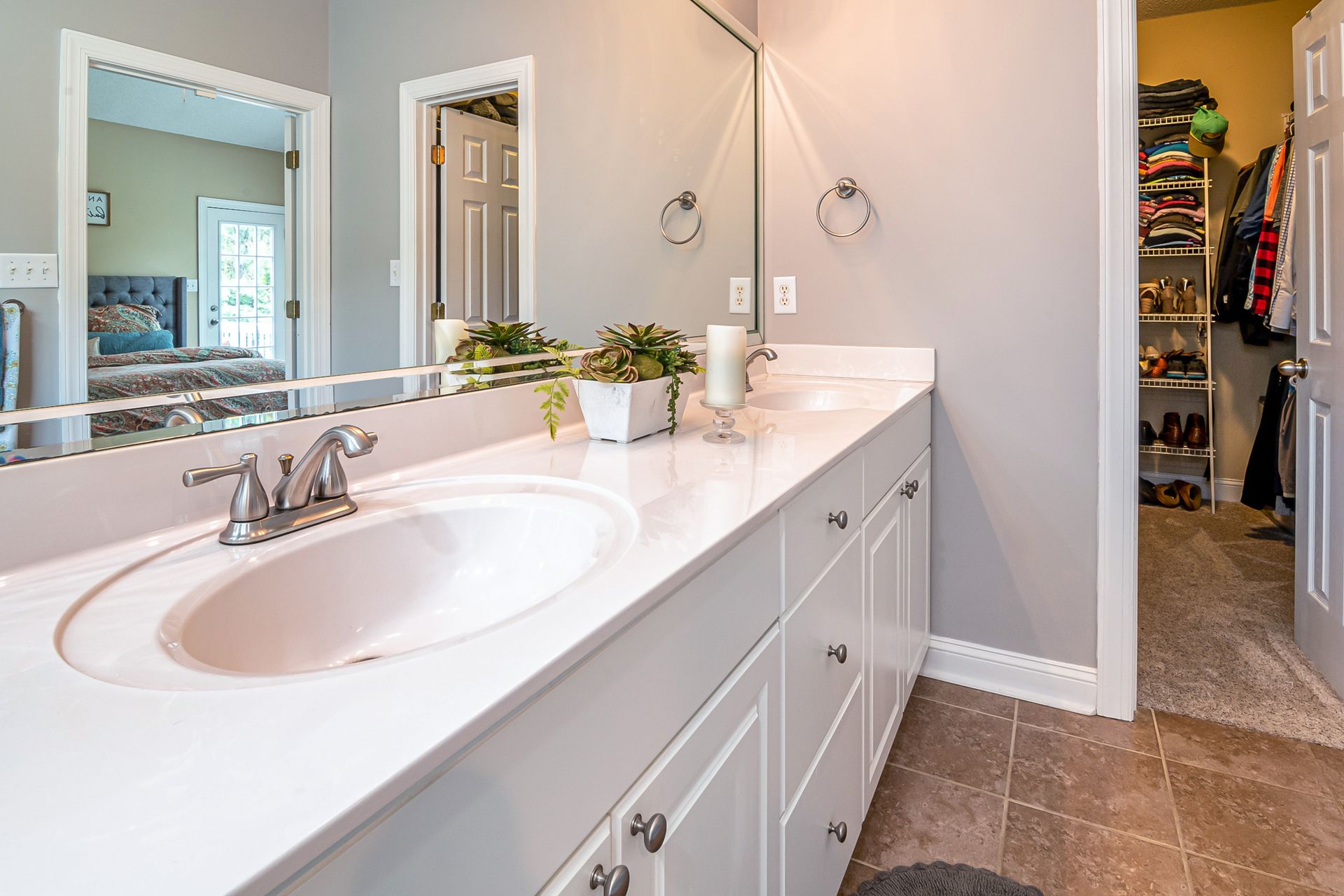
Width. The mirror should be at least as wide as the vanity — ideally spanning the full width of the vanity cabinet, countertop to countertop. A mirror narrower than the vanity looks pinched and out of proportion. Going wider than the vanity (extending to the full wall between the tile and the adjacent wall) is also fine and makes the space feel larger.
Height. Standard bathroom mirrors sit with the bottom edge 5–8 inches above the countertop. The top edge depends on ceiling height and your preference — going close to the ceiling makes the room feel taller. For double vanities, a single large mirror spanning both sinks reads as more cohesive and modern than two separate mirrors.
Edge vs. frame. A polished or beveled edge on a frameless mirror works in contemporary and transitional bathrooms. If your bathroom has a more traditional millwork style, a framed mirror (framed by your contractor or a millwork shop, with us supplying the mirror glass) may be more appropriate. We supply mirror glass to framers as well as full frameless installations.
We serve homeowners throughout Orange, Ulster, and Dutchess Counties — Newburgh, Middletown, Goshen, Kingston, New Paltz, Poughkeepsie, Beacon, Fishkill, and all surrounding areas. Many custom mirrors are ready the next business day for pickup or delivery. Call (845) 562-8387.
Written & verified by
Rick Powles
Owner & Operator, Nu-Glass & Storefronts, Inc.
Rick Powles has measured, fabricated, and installed commercial glass and glazing systems across the Hudson Valley since 1989. As owner-operator, he is on every job — storefronts, curtain wall, frameless showers, and everything in between.
FAQs
Frequently asked questions
-
Can you cut a mirror to my exact size?
Yes — bring your measurements or have us come out and measure. We cut custom mirrors to any rectangular size with your choice of edge finish. Most are ready the next business day. Complex shapes (oval, arch, custom cutouts) take a bit longer.
-
Do you install mirrors as well as cut them?
Yes. We install wall mirrors with the appropriate mounting system — clips, French cleats, or adhesive — depending on the size and weight of the mirror and your wall type. We handle the full job from cut to mounted.
-
What edge options are available?
Polished edge (bright, clean), beveled edge (angled grind around the perimeter, decorative), seamed edge (for framed mirrors where the edge will be covered), and sandblasted edge (frosted finish). We'll recommend what looks right for your application.
-
Can you install full-wall gym mirrors?
Yes. We lay out, cut, and install full-wall gym mirrors in panels sized for the space. We mount with French cleats for a secure installation that can be adjusted or removed, and we align all panels to the same level and plumb line across the wall.
-
How long does a custom mirror take?
Most standard rectangular custom mirrors are ready the next business day from your measurements. Custom shapes, large-format mirrors, and beveled edges may take a few extra days. Gym mirror installations are scheduled separately after a site visit.
Get Started
Need custom mirrors?
Call the shop or request a free estimate — we'll measure, quote, and get it done right.